
Branding for AI Businesses: Why Your Brand Strategy Matters More Than Ever
Feb 27, 2026Branding for AI businesses isn't just about looking modern or tech-forward. It's about helping your customers understand what you do, trust that it works, and believe it's worth paying for.
AI is changing the way businesses operate from the inside out. If it's transforming your internal processes, your workflows, and your offers, it should be transforming your marketing too. But just because you've added AI to your product or service doesn't mean your customers automatically see the value in it. That's where branding comes in.
Your Customers Don't Understand AI (Yet)
There's a lot of noise around AI right now. Some think it's revolutionary. Others are skeptical. Most are somewhere in between: confused, a little fatigued, and wary of products that overpromise and underdeliver.
When a customer doesn't understand something, they undervalue it. And when they undervalue it, they don't buy it or they expect to pay less for it. Confusion leads to hesitation, comparison shopping, and lost sales.
The businesses that make AI understandable will capture disproportionate market share. And the way you make it understandable is through brand strategy.
Common Mistakes Businesses Make When Marketing AI Products
Before we talk about what works, let's talk about what doesn't. Here are the biggest mistakes I see when branding for AI businesses.
1. Making AI the headline instead of the hero. AI isn't the product — your product is the product. AI is what makes it exceptional. Creating ads with, "We use AI" is like a restaurant marketing, "We use ovens." What matters is the result. Think about what your product or service delivers for your customer, and let AI be the reason it delivers it so well.
2. Leading with features instead of value. Customers don't care how your AI works. They care what it does for them. "Uses machine learning" means nothing. "Saves you 3 hours a week" is better, but showing an actual before and after of building an app without having to use code is best.
3. Looking like every other AI brand. Stars, purple gradients, blue color schemes, "magical" and "futuristic" everything. It all blurs together. If your brand looks like every other AI product on the market, customers have no reason to choose you over a competitor.
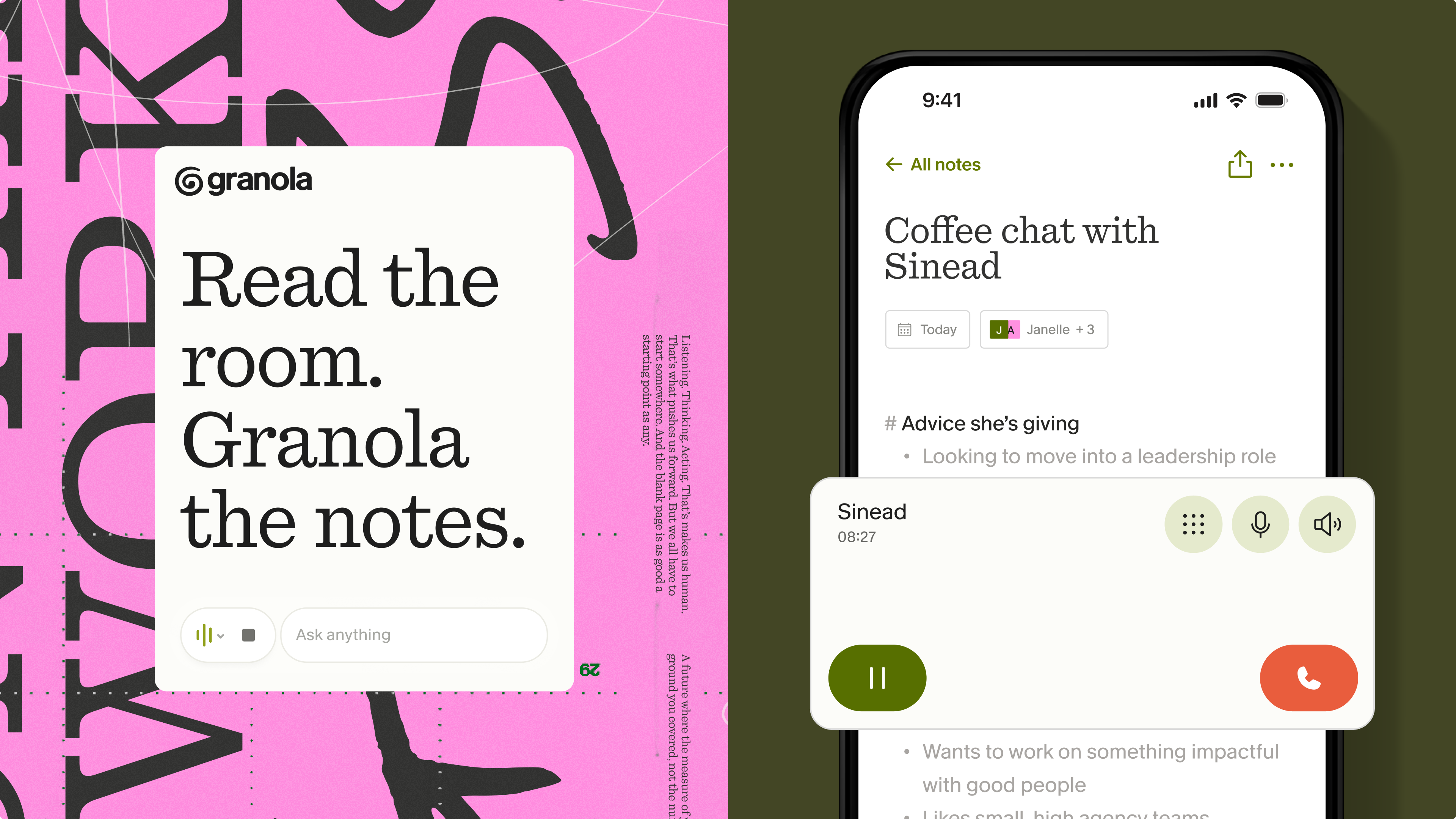
A Brand Getting This Right: Granola
Granola is an AI-powered note-taking app, and they're a great example of branding for AI businesses done well.
The product connects to your meetings, records on your own device, transcribes the conversation, and generates clean organized notes automatically. It also integrates with Slack and Teams so you can send follow-ups without switching apps. It's genuinely useful, but so are a lot of tools.
What makes Granola stand out is how they've branded it.
Most AI companies go for a sleek, futuristic look: cool blues, abstract shapes, interfaces that feel like they belong on a spaceship. Granola did the opposite. Their branding is warm and analog. Think notebook textures, paper-like backgrounds, handwritten fonts, and earthy colors that feel familiar rather than intimidating. Even the visual metaphors they use (shells, maps, documents) are things customers already understand.
It's a smart move. Instead of asking customers to understand the technology, they made it feel like something they already know. Customers focus on the benefit (better notes, less stress after meetings) rather than getting hung up on the AI behind it.
What This Means for Your Business
Adding AI to your offer suite isn't just a product update — it's an opportunity to increase your value, position your business as a premium option, and build deeper trust with your audience. Here's how to make that happen.
-
Help them understand it. You don't need to get technical, but you do need to give your audience enough context to feel confident. Explain how it works in plain language and, more importantly, what it means for them specifically.
-
Connect it to the problem they already have. Your AI integration should map directly to a pain point your customer already feels. Lead with that emotional need first, and let the AI be the solution.
-
Make it human. What that looks like will be different for every business — some audiences want warmth and personality, others prefer a cleaner, more transactional experience. Research suggests people are genuinely split on this. The key is knowing your audience and designing your brand experience around what makes them feel most comfortable.
-
Make sure your visuals match your message. If you're promising a warm, intuitive experience, your brand should look and feel that way too. Misalignment between your visuals and your message creates distrust, even if customers can't articulate why.
-
Be consistent. Trust is built over time. Your messaging, visuals, and tone need to tell the same story across every touchpoint, every time.
The Bottom Line
AI is still new to a lot of customers, and most businesses haven't figured out how to talk about it in a way that actually resonates. That's a huge opportunity, but it won't last forever. Technical capabilities are becoming commoditized fast, and feature parity across industries is increasing. The businesses that invest in brand strategy now will build trust faster, command premium pricing, and create a competitive advantage that's much harder to copy than any feature.
Features get copied. Brands don't.
If you're ready to build a brand strategy that makes your AI offering impossible to ignore, let's talk.
Free Branding Guide
Want to put these tips to
work on your own brand?
Enter your information below to receive 5 Things to Do Before You Rebrand: the complete step-by-step guide to preparing your business for a rebrand that will improve your reputation and increase your revenue!
By submitting this form, you’re signing up to receive my free newsletter, which sometimes includes mentions of my products + services. You can opt-out at any time 😉 Your information is never shared or sold.